
How to Check Criminal History in Robertson County
No single Robertson County search returns every arrest, filed charge, court result, and custody event. Start with the event you know. A recent booking belongs at the Robertson County Sheriff's Office, a felony case belongs with the District Clerk, and a Class A or B misdemeanor belongs with the County Clerk. Fine-only cases can remain with a municipal or justice court. The Texas Department of Public Safety adds a statewide public conviction search, but that product is not a full fingerprint-linked rap sheet.
Gather the full name, date of birth if available, event date, city, arresting agency, and any cause or booking number. Small spelling shifts can hide a result. Then use this order:
- Search the RCSO current and released roster for recent county custody.
- Ask the County Clerk about misdemeanor records or the District Clerk about felony records.
- Contact the arresting police agency for its incident narrative rather than asking the jail for a city report.
- Compare the filed charge and judgment with the booking allegation.
- Use DPS fingerprint personal review when checking or correcting your own identity-linked Texas history.
A certified court copy must come from the clerk. A sheriff report must come from RCSO or the city police department that made it. Keeping those roles separate avoids a common records dead end.
Three Robertson County Record Counters
Robertson County's justice offices form a practical triangle in Franklin. The historic courthouse is the County Clerk and constitutional county court stop. The District Clerk works from the Second Floor Annex on East Morgan Street. The sheriff and jail share the Highway 79 complex. These offices are close in county terms, yet each holds a different slice of a criminal history.
The official Robertson County office hub shows the courthouse used as the county's visual center.
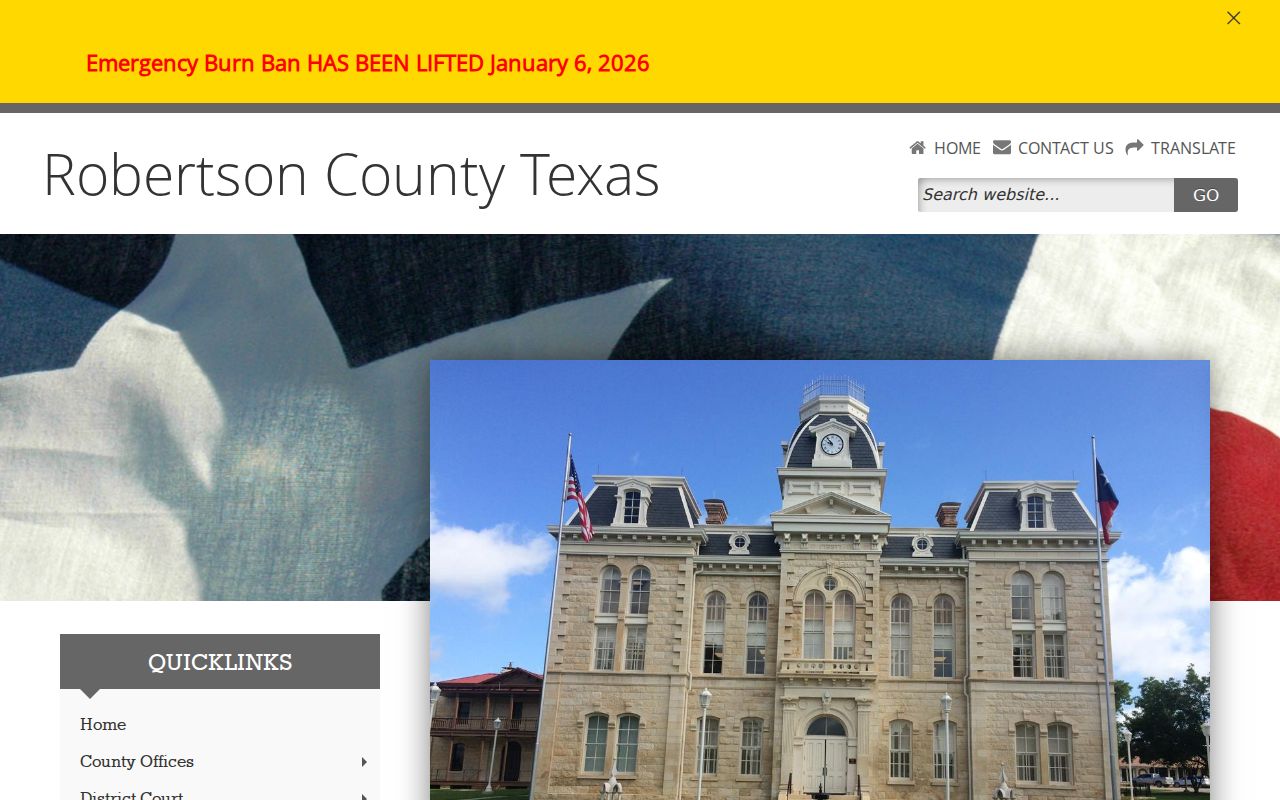
The courthouse image is a useful landmark, but felony file requests still go to the annex rather than a general courthouse counter.
County Clerk
102 W. Decherd St.
Franklin, TX 77856
979-828-4130
District Clerk
103 E. Morgan St., 2nd Floor Annex
Franklin, TX 77856
979-828-3636
RCSO Records Division
1006 W. US Highway 79
Franklin, TX 77856
979-828-3299
Official Texas Background Checks
The Texas Department of Public Safety Crime Records Division maintains the state repository. Its public Criminal History Conviction Name Search costs one $3 search credit, plus portal or payment charges, and a no-hit search still uses the credit. It mainly returns the conviction and deferred-adjudication information that Government Code Chapter 411 permits DPS to disclose and that agencies have successfully reported. Since the search is based on a name rather than fingerprints, a common name can produce a false match or miss the correct person.
A personal record review is different. DPS uses fingerprints captured through FAST, the Fingerprint Applicant Services of Texas program administered by IdentoGO. The person reviewing their own history can then spot an arrest cycle with a missing or mismatched disposition. No verified enrollment center inside Robertson County was found in the official material, so use the live scheduler instead of an old location list.
The official FAST appointment scheduler requires the service code supplied for the authorized purpose.
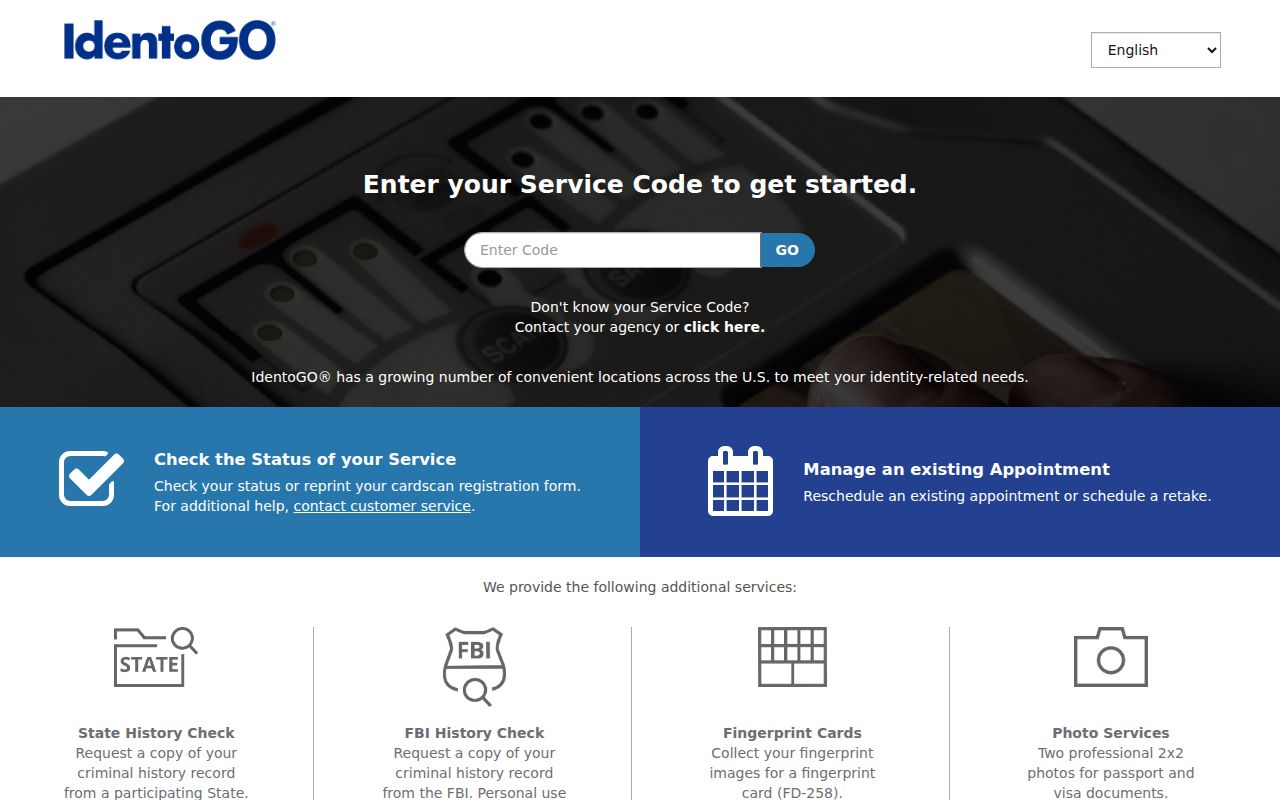
The scheduler controls the current site choice, appointment fields, identity-document instructions, and fee shown for that service code.
Robertson County Record Check Choices
Name checks and fingerprint reviews answer different questions. A Robertson County name search can be useful for locating a public case or the statewide conviction subset. It does not prove identity. Fingerprints tie a person to Texas arrest cycles and are the sound route for reviewing one's own record or asking DPS to correct a reporting problem.
| Channel | Best use | Main limit |
|---|---|---|
| Robertson clerks | Filed local case and final disposition | Does not cover other counties |
| DPS public name search | Public statewide conviction and deferred-adjudication slice | Name is not fingerprint-confirmed |
| DPS personal review | Your identity-linked Texas record and correction work | Requires the official fingerprint process |
| FBI Identity History Summary | Your federal and multistate identity history | Subject request with fingerprints and an $18 FBI fee |
For an FBI review, the subject can use the FBI Electronic Departmental Order process. Local clerks cannot turn a Robertson County case search into a national check.
Types of Criminal Records
A criminal event creates several records rather than one universal file. The arresting agency writes the incident or arrest report. Robertson County Jail creates the booking record if the person enters county custody. A prosecutor chooses the filed charge, and the proper clerk then keeps the case. DPS receives fingerprint and disposition data through the Texas reporting network. Each item has its own custodian, timing, and access rule.
- Arrest and offense reports: narratives kept by RCSO, a city police department, or the other agency that made the report.
- Booking records: jail intake details, bond, listed charges, booking identifiers, and release status.
- Court files: complaints, informations or indictments, motions, settings, pleas, orders, judgments, and sentences.
- Warrant records: process issued by a court and tracked by law enforcement, with access that can change before service.
- Custody and supervision records: county jail, TDCJ, probation, and parole records held by different offices.
- Registry records: qualifying registration information published through the Texas Public Sex Offender Registry.
The Robertson County arrest history resource follows the full report and booking chain without treating an arrest as a conviction.
Robertson County Jail Roster Records
The RCSO roster is the fastest official starting point for current or recently released county custody. It accepts either a first or last name, provides Current and Released filters, lets the reader sort by name or date, and offers newest-to-oldest and oldest-to-newest controls. Show All and page controls help when spelling is uncertain. A released card may show release time, while a current card does not.
The Robertson County inmate roster interface displays these local search controls.
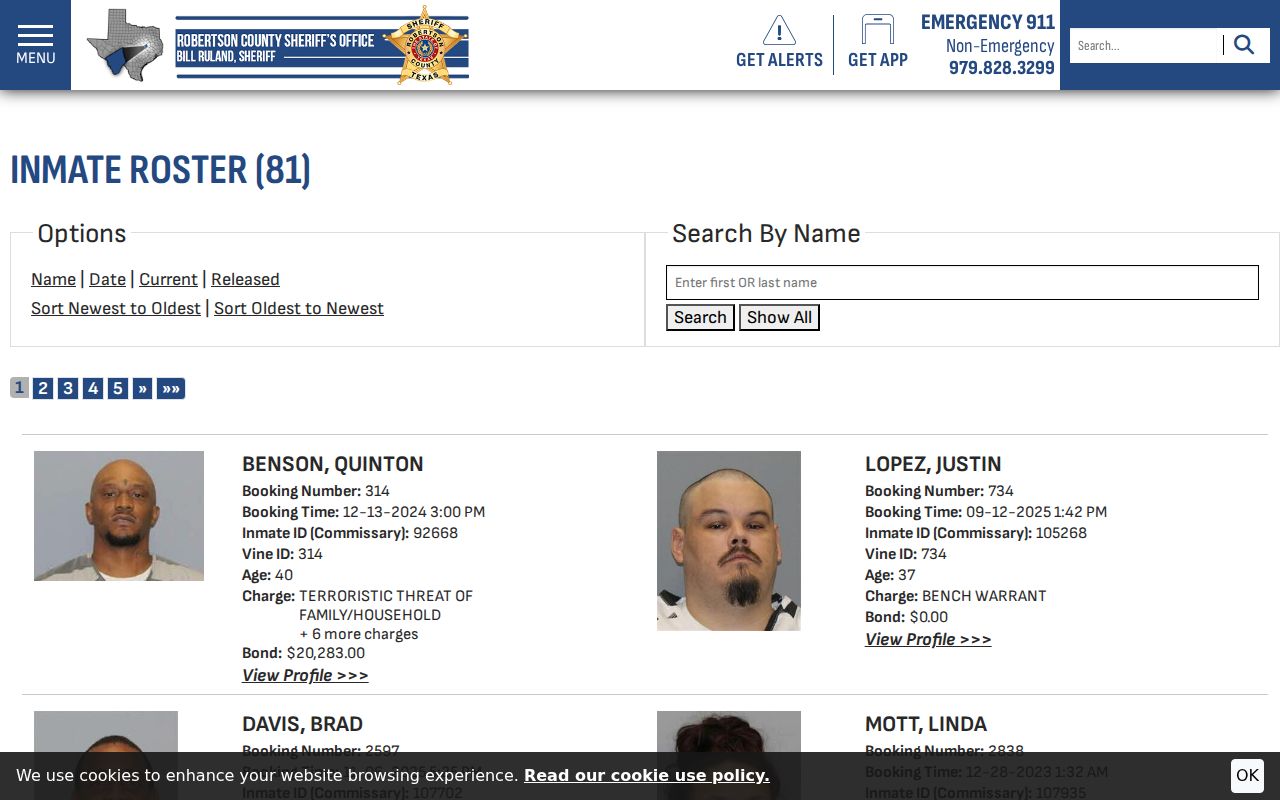
The interface is a lead, not a certified record. RCSO warns that it cannot certify the accuracy or authenticity of the public-source information shown there.
| Roster control | What it does | Useful follow-up |
|---|---|---|
| First or last name | Runs a single-name search | Try a spelling variant |
| Current | Shows people displayed as held | Call the jail if custody is urgent |
| Released | Shows recent release entries | Note the release time and booking number |
| Date sort | Changes booking order | Use the event date to narrow the list |
What a Robertson County Criminal Record Shows
The fields depend on which record is open. A Robertson County jail card centers on booking and custody. A clerk file centers on a cause number and prosecution. A DPS identity record joins reported arrest cycles to later prosecutor and court outcomes. Reading the label at the top matters as much as reading the charge itself.
| Name and identifiers | Names, aliases, date of birth or physical descriptors where public, plus booking, SID, FBI, VINE, or cause numbers as the system uses them. |
|---|---|
| Arrest and booking | Arrest date and agency, booking time, intake charge, bond, and current or released status. |
| Filed charge | The complaint, information, or indictment that controls the prosecution rather than the intake shorthand. |
| Disposition | Dismissal, acquittal, conviction, deferred adjudication, or another court result. |
| Sentence | Custody, fine, community supervision, restitution, and other terms stated in the judgment. |
| Access status | Public, redacted, restricted by nondisclosure, or removed under a qualifying expunction order. |
Some values will not appear in every public view. Robertson County roster cards inspected did not consistently expose an arresting agency, warrant number, date of birth, magistrate, pod, or court date, so those fields should be confirmed from the source office.
Robertson County Charges Can Change
A booking charge reflects the allegation recorded at intake. It is not the prosecutor's last word. The Robertson County District Attorney may reject, add, reduce, or revise charges before an information or indictment is filed. A person can also be released from jail while the criminal case remains open. For that reason, neither release nor a missing booking card proves dismissal.
- Disposition
- The result of a charge or case, such as dismissal, conviction, or acquittal.
- Information
- A prosecutor-filed charging instrument commonly used for a misdemeanor.
- Indictment
- A grand jury's formal felony accusation, also called a true bill.
- Deferred adjudication
- A Texas outcome that defers a final guilt finding during community supervision and can remain reportable.
- Nolle prosequi
- A formal prosecutor decision not to continue a charge, which is not a conviction.
Record flow: Arresting agency › Robertson County Jail › prosecutor › County or District Clerk › Texas DPS.
When a DPS record lacks a later Robertson County result, obtain a certified clerk disposition first. DPS correction instructions can then connect the missing outcome to the correct arrest cycle.
Public Access Laws
The Texas Public Information Act generally applies to records held by executive agencies, including public portions of an RCSO report. Court records use the judiciary's access rules and the clerk's own procedures instead. DPS criminal-history dissemination follows Government Code Chapter 411. That split explains why one broad request sent to the county cannot compel every office to return every part of a criminal history.
Key Texas authorities:
Government Code Chapter 552 provides access to public information and sets exceptions and withholding procedures.
Government Code Chapter 411 limits criminal-history dissemination while authorizing a defined public conviction product.
Code of Criminal Procedure Chapter 55A controls qualifying expunction cases after the 2025 recodification.
Code of Criminal Procedure Chapter 62 governs Texas sex offender registration duties.
Active-investigation facts, juvenile information, protected victim or child identifiers, financial account data, and other confidential material may be withheld or redacted. A public record also does not prove that an allegation was sustained.
Robertson County Sheriff Record Requests
A written request is the formal fallback when the RCSO roster does not show enough detail. The Records Division accepts requests in person at 1006 W. US Highway 79, by mail at P.O. Box 1109, Franklin, TX 77856, by fax at 979-828-5845, or by email to info@robertsoncountysherifftx.org with “Records Division” in the subject. The 24-hour number, 979-828-3299, can help confirm custody and routing, but a written request leaves a clear trail.
Give the report number when known. Otherwise identify the incident type, occurrence date, location, parties, and the exact records sought. The RCSO forms and records page warns that autopsy files, lab results, city police reports, and statewide criminal history belong with their actual custodians. Sending each request to its creator saves time.
Robertson County does not publish a flat sheriff report fee or guaranteed delivery time in the reviewed source. Ask for a cost estimate before approving a large request. The Texas ten-business-day rule concerns when an agency may need to seek an Attorney General decision to withhold information; it is not a promise that all records arrive within ten days.
Sealed, Expunged & Restricted
Texas expunction and nondisclosure do different work. Expunction is the stronger and narrower remedy. A qualifying order directs named agencies to destroy, delete, return, or remove records as Chapter 55A provides. Nondisclosure restricts ordinary public release of qualifying criminal-history information but still permits access by criminal justice agencies and other entities listed in Chapter 411.
A Robertson County filing depends on the arrest, every related charge, the disposition, waiting rules, and the person's history. Acquittals, pardons, identity-theft cases, and some dismissals or cases never filed may qualify, but the statute controls. Completing deferred adjudication more often points toward nondisclosure than expunction. Never infer eligibility from a short roster charge.
Collect the arresting-agency report, booking identifiers, DPS personal record, and certified clerk result. Then ask the Robertson County District Clerk for the current local filing method, service requirements, hearing practice, and fee. The reviewed research did not establish a current expunction filing total. Texas Judicial Branch forms and eligibility tools are the safer starting point for nondisclosure.
Robertson County Custody Record Layers
County jail custody, state imprisonment, and parole review are separate record systems. Search RCSO for a current or recent local detainee. After a state jail or prison sentence, use TDCJ. A county pretrial detainee will not normally appear in the state locator merely because the pending charge is a felony.
The TDCJ Online Inmate Search is the official state custody channel.
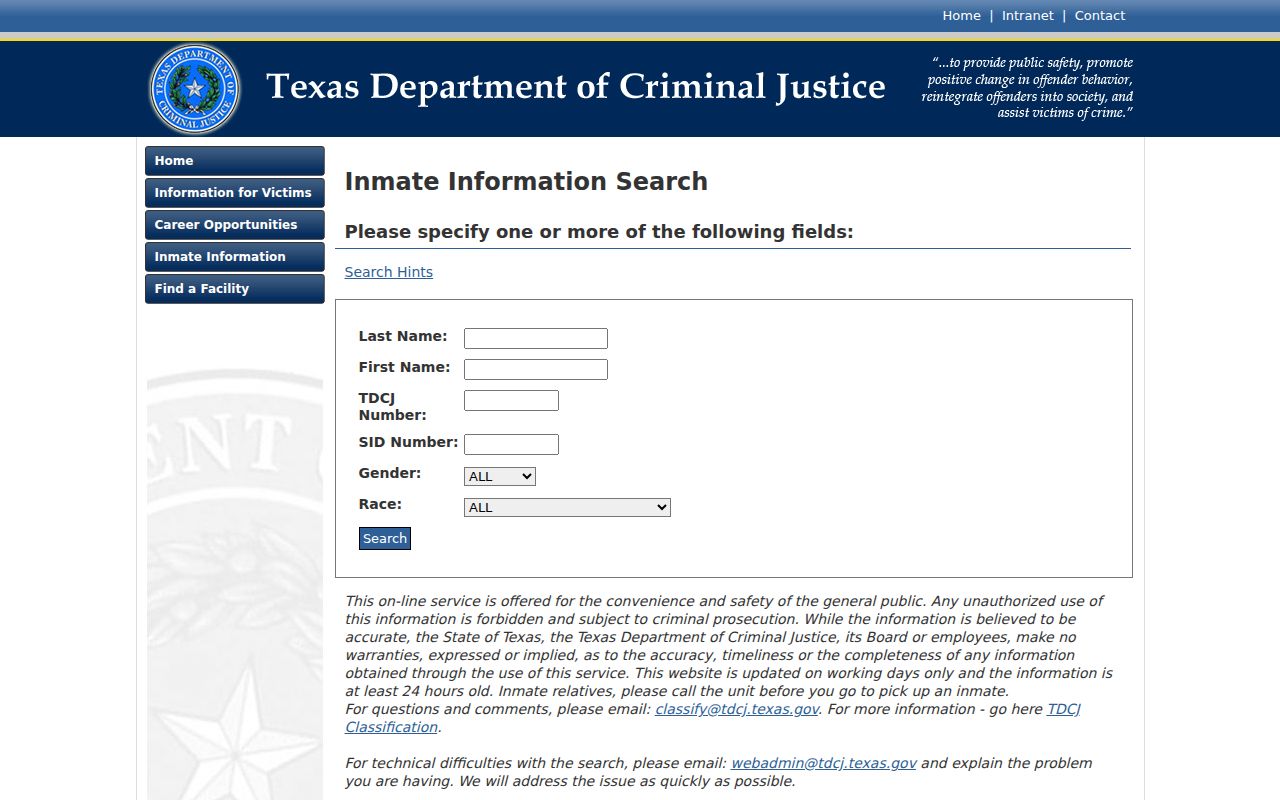
The locator can be supplemented by TDCJ phone service at 936-295-6371 or 800-535-0283 on weekdays from 8 a.m. to 5 p.m.; staff require the exact birth date when no TDCJ or SID number is supplied.
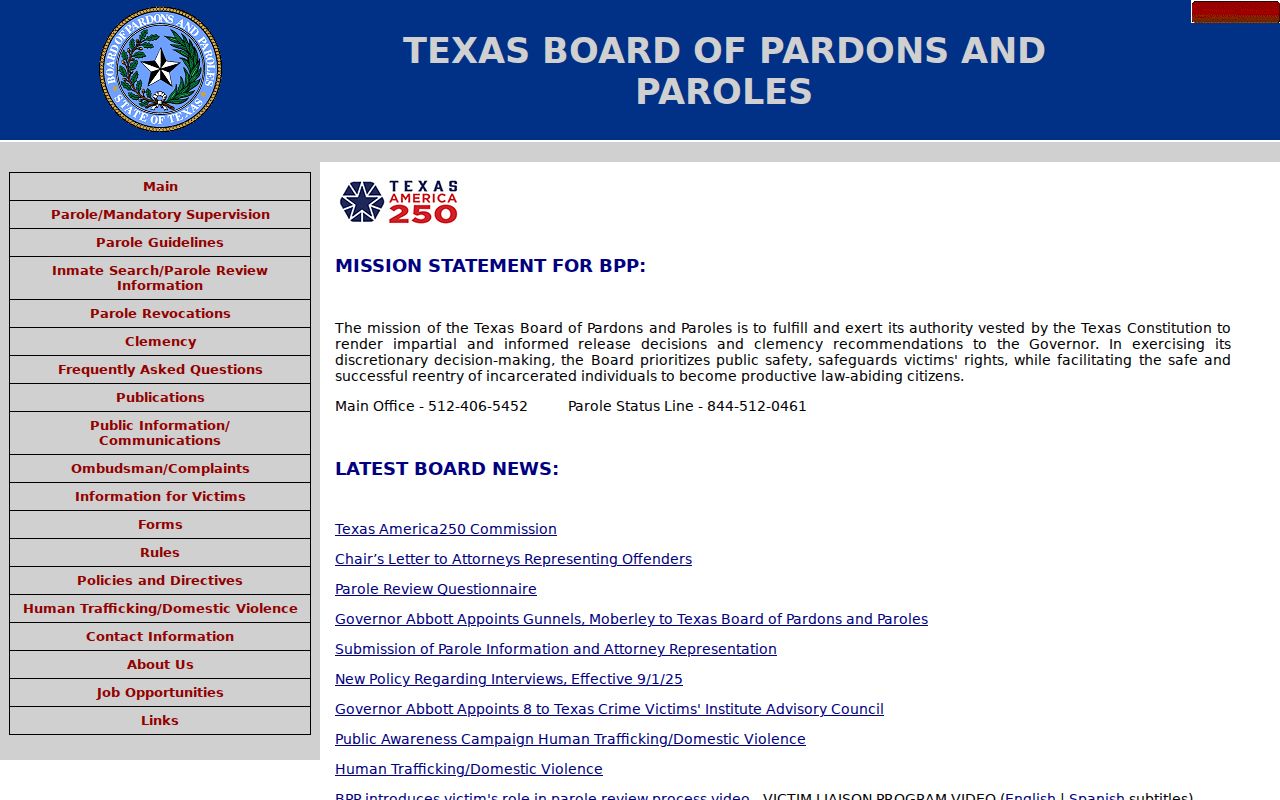
Parole decisions belong to the Texas Board of Pardons and Paroles, while supervision after release belongs to the TDCJ Parole Division. The Board's official information page illustrates that separate decision layer.
For a Robertson County sentence, the clerk's judgment remains the best public proof of what the court ordered. Supervision notes are not the same as that judgment.
Criminal Records by City in Robertson County
City police departments create their own incident reports, and city courts hold their own fine-only cases. Hearne is Robertson County's largest incorporated city, Franklin is the county seat, and Calvert ranks third. A person booked at the Robertson County Jail may therefore have a city police narrative, a county booking card, and a court file kept at yet another counter.
Hearne Criminal History
Hearne Police reports and Municipal Court records share a Third Street address but remain separate files.
Franklin Criminal History
Franklin Police keeps city reports, while RCSO supplies the city jail and dispatch functions.
Calvert Criminal History
Calvert court questions use the Main Street counter and its posted phone schedule.
Fine-only city warrants may not appear on the 82nd District felony docket. Contact the issuing municipal court with a citation or cause number before relying on a county-level search.
Robertson County and Federal Records
Federal cases form another layer. Robertson County lies in the Western District of Texas, Waco Division. PACER holds federal docket entries and documents after registration. Its judiciary fee is $0.10 per page with a $3 document cap in most cases, and quarterly charges of $30 or less are waived under the current schedule. PACER does not replace a Robertson County clerk search.
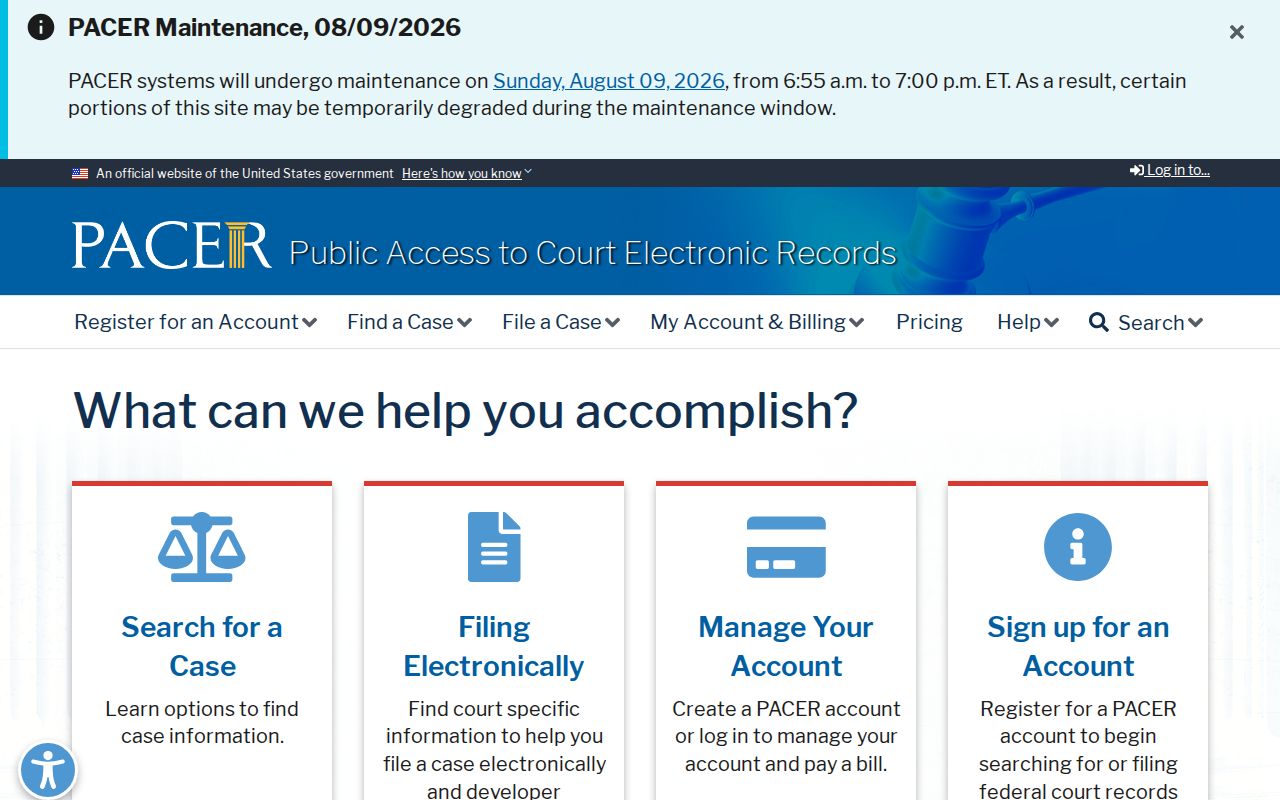
The official PACER service is the source for federal court records.
The federal Bureau of Prisons locator is likewise limited to federal custody. A federal defendant may remain in a local or contract facility before designation, so the federal docket can be more useful during a pending prosecution.
Robertson County itself covers 855.16 land square miles and had 16,757 residents in the 2020 Census. The July 2025 estimate was 17,839. Those facts help explain why records are centralized in Franklin even though Hearne has the largest city population. They do not establish a crime rate. Live booking totals are snapshots of custody and should never be converted into claims about community crime.